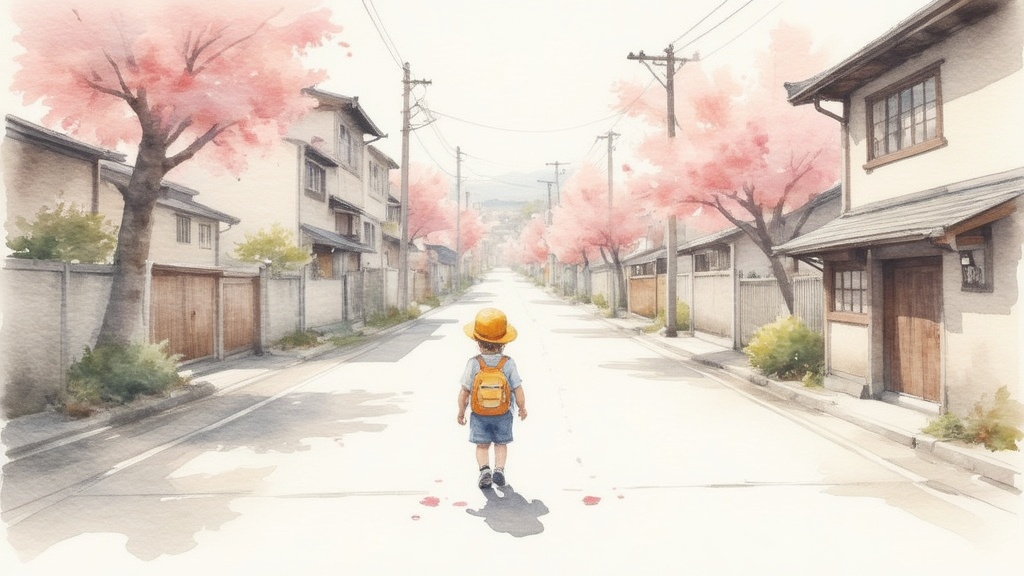
My son was eight months old when Netflix recommended a show called Old Enough! — a Japanese program where toddlers as young as two are sent on solo errands through busy neighbourhoods. I watched a three-year-old navigate a fish market, cross a road, and deliver groceries to her grandmother. My son was sitting on my lap eating his own fist.
I did what any reasonable person would do: I went down a research rabbit hole that lasted three weeks.
What I found wasn’t what the Netflix algorithm was selling. The show is real, the cultural value it captures is real, but the picture most Westerners have of Japanese childhood independence — tiny children roaming free in a society that simply trusts them more — is a comfortable distortion of something far more interesting. And far more useful.
Because the Japanese don’t just allow childhood independence. They engineer it. Every walking route is mapped. Every neighbourhood has designated safe houses. Older children escort younger ones in organised groups. The community watches. The infrastructure does the heavy lifting. And the child, inside that scaffolding, does something Australian children increasingly never get to do: practise being competent in the real world.
The Japanese don’t just allow childhood independence. They engineer it. And the child, inside that scaffolding, does something Australian children increasingly never get to do: practise being competent in the real world.
First, the show versus the reality
Hajimete no Otsukai (“My First Errand”) has been running in Japan since 1991, inspired by a 1976 picture book by Yoriko Tsutsui and Akiko Hayashi. The children featured range from one year eight months to five years three months. Camera crews wear disguises. No accidents have occurred in over 30 years of production.
It’s great television. It is not documentary evidence of how Japanese families actually operate.
A Tokyo Weekender analysis by a parent with experience across Japan, the US, and New Zealand notes plainly: “it is school-age children who are often out alone, not preschoolers.” The cultural practice of children running errands is real, but it applies primarily to children aged six and above. No rigorous survey data exists documenting how widespread solo errands by preschoolers actually are.
The show amplifies a genuine cultural value — captured by the Japanese proverb kawaii ko ni wa tabi o saseyo, “send the beloved child on a journey” — but it shouldn’t be confused with everyday practice for two-year-olds. Think of it as a culture revealing what it aspires to, not a hidden camera catching what it routinely does.
The real story starts at age six. And it starts with walking to school.
93% of Japanese children walk to school. Alone.
The Japan Sports Agency’s 2018 national survey was not a sample. It was a full census of all 1,095,282 fifth-graders in the country. It found that 92.4% of boys and 93.5% of girls walked to school. Only 1.7% rode a bus. A 2025 prospective study confirmed walking rates of 94.7–96.1%.
Let that land for a second. In a country of 125 million people, virtually every primary school child walks to school.
A census of all 1,095,282 Japanese fifth-graders found 92.4% of boys and 93.5% of girls walked to school. Only 1.7% took a bus. The Global Matrix 4.0 on physical activity across 57 countries gave Japan the highest rating (A−) for active transport to school.
The Policy Studies Institute’s landmark study — 18,303 children aged 7–15 across 16 countries — ranked Japan fifth for children’s independent mobility overall, behind Finland, Germany, Norway, and Sweden. Australia ranked near the bottom, comparable to Ireland and Brazil. E. Owen Waygood at Montréal Polytechnique found that Japanese children aged 10–11 make just 15% of their weekday trips with a parent. For American children the same age, that number is 65%.
The comparison that haunts me most: in England, 80% of 7–8-year-olds walked to school without an adult in 1971. By 2006, only 12% did. In Australia, children aged 5–9 who walked to school dropped from 57.7% in 1971 to 25.5% by the early 2000s, while car travel nearly tripled. We didn’t make a conscious decision to stop letting children walk. It just happened, one anxious school drop-off at a time.
But this isn’t “free-range” anything
Here’s where most Western coverage of Japanese childhood independence gets it wrong. The independence is real, but it’s not the absence of structure. It’s structure of a completely different kind.
Before a Japanese child’s first day of school, their parents must draw a detailed map of the walking route — the tsuugaku-ro — and file it with the school. Teachers and local residents determine which routes are safest. School zones are closed to vehicular traffic during commute times. Children walk in neighbourhood groups called han, with older students leading younger ones. First-graders wear bright yellow caps and carry randoseru backpacks that signal to every adult in the neighbourhood: this child is walking to school. Watch over them.
The community does watch. Japan has a concept called mimamori (見守り) — literally “watching and protecting.” It operates as both a pedagogical philosophy and a community practice. Organised networks of volunteers, parents, and residents patrol school routes. Homes and businesses display “110 House” signs (kodomo 110-ban) indicating they’re designated safe havens for children — the number refers to Japan’s police emergency line. Post offices and convenience stores participate. GPS services like BoT Talk (Japan’s most popular children’s tracking device) and specialised children’s phones with no internet access round out the system.
This is not parents backing off. This is an entire society deciding that childhood independence is worth investing in, and then building the infrastructure to make it safe.
The infrastructure that makes independence possible
Three structural features enable Japanese childhood mobility in ways that have no real equivalent in Australia.
Crime rates that are almost incomprehensibly low. Japan’s homicide rate is 0.2 per 100,000 — compared to Australia’s roughly 0.8–1.0 and the United States’ 5.3. The robbery rate comparison is more dramatic: Japan at 1.8 per 100,000 versus the US at 98.6. These aren’t marginal differences. They’re different worlds.
Urban design built around walking. Japanese cities plan neighbourhoods on a five-to-ten-minute walking radius with mixed-use zoning that places schools, shops, and clinics within walking distance. The School Education Act requires elementary schools to be sited within four kilometres of children’s homes. Residential streets are narrow, winding, and designed as T-junctions or cul-de-sacs — creating de facto traffic calming without the need for speed bumps and signage. Japan’s road mortality rate is 2.6 deaths per 100,000 population, making it the fourth-safest country in the OECD.
Schools that treat independence as curriculum, not a side benefit. Japan’s national Tokkatsu framework — “special activities” mandated by the Ministry of Education — embeds responsibility into the school day. Students clean their own classrooms, hallways, and shared spaces for 15–20 minutes daily from first grade (sōji). They serve lunch to their classmates in rotating duty groups (tōban), wearing white aprons and caps, collecting food from the kitchen, serving portions, and cleaning up. Every student rotates through every role. There are no permanent monitors, no elected positions, no star-chart rewards. Just the daily practice of being responsible for your shared space.
(A quick myth-correction: Japanese schools do have janitors. They’re called yomushuji. Students handle daily tidying; professionals handle maintenance and deeper cleaning. The “no janitors in Japanese schools” line makes for a good tweet but doesn’t survive contact with reality.)
The largest cross-national study of children’s independent mobility: 18,303 children aged 7–15 across 16 countries. Japan ranked 5th globally. Australia ranked near the bottom. Finland, Germany, Norway, and Sweden led the rankings.
The paradox at the heart of it
Here’s where it gets genuinely interesting — and where the Netflix narrative falls apart.
Japanese psychology has a concept called amae, introduced by psychiatrist Takeo Doi in 1971. Roughly translated, it’s the desire to be indulged and taken care of — a kind of dependency that Japanese culture views not as weakness but as the foundation of close relationships. Japanese mothers tend to maintain extremely close bonds with their children, and researchers have found they interpret dependency behaviours as healthy expressions of closeness rather than something to be discouraged.
Western attachment theory says: secure attachment produces independence. Japanese developmental culture says: deep dependency and early independence aren’t contradictory. They’re complementary. The child ventures out because the bond is secure, and the independence is scaffolded collectively — walking groups, neighbourhood patrols, school-managed routes — rather than being purely individual.
A cross-cultural study by Chirkov, Ryan, Kim and Kaplan across 559 people in South Korea, Russia, Turkey, and the US found that autonomy was positively associated with wellbeing in every sample — including the collectivist ones. The critical insight: autonomy doesn’t mean individualism. You can be “autonomously collectivistic.” You can feel self-directed while doing something your community values. That’s what a Japanese six-year-old walking to school in a han group is doing.
A massive analysis of PISA data across 92,325 students from 11 societies — including Japan, Australia, the US, and the UK — confirmed it: autonomy support was equally important for student achievement in both Western and Eastern cultures. The idea that autonomy only matters in individualistic societies doesn’t hold up.
This matters. Not just for understanding Japan, but for understanding what Article 3 in this series was about. If autonomy support predicts wellbeing across cultures, then helicopter parenting isn’t just a Western problem with Western consequences. It’s a universal constraint on a universal need.
Now for the part most articles leave out
I could stop here and you’d walk away thinking Japan has it figured out. They don’t.
UNICEF’s Innocenti Report Card ranks Japan first of 36 wealthy countries in children’s physical health. That same report ranks Japan 32nd in mental wellbeing. Thirty-second out of thirty-six.
Suicide is the leading cause of death among Japanese children and teenagers — a distinction unique among G7 nations. In 2024, 529 school-aged youth died by suicide. A record. School refusal reached 353,970 cases in the same year, the twelfth consecutive annual increase. Also a record.
The Ministry of Education recorded 769,022 bullying cases in 2024, a 5% increase and the largest number ever. And this isn’t the kind of bullying most Westerners picture. Ijime — Japanese bullying — is fundamentally group-based. A 2025 study using PISA 2018 data found that the same cooperative cultural norms Western observers admire can lead to heterogeneous individuals being viewed as less cooperative — and targeted. The conformity that produces those beautiful school lunch routines also produces exclusionary violence against anyone who doesn’t fit.
The lesson from Japan isn’t that their system produces uniformly good outcomes. It’s that you can build extraordinary infrastructure for childhood independence and still have a system that crushes children in other ways. Independence within a conformity-driven culture creates its own pathologies. The practices are worth studying. The system is not worth romanticising.
There’s a term — hikikomori — for the roughly 1.46 million Japanese people aged 15–64 who have withdrawn from social life entirely. A 2024 population-based study found strong correlations with truancy, unemployment, and the absence of ibasho — a place of belonging. Some researchers frame hikikomori as the system’s shadow: Japan fosters extreme maternal dependence, then demands conformity and performance in a rigid hierarchy. Those who can’t make the transition withdraw. The independence practices exist within a broader system of pressure that produces both high-functioning children and severe social collapse.
Any honest article about Japanese childhood independence has to hold both of these truths at the same time.
What Australia can actually learn from this
In 1970, 84% of young Australians walked, cycled, or took public transport to school. Today, most are driven. Children aged 10 and under travelling home from school alone dropped from 68% in 1991 to 31% by 2012, according to the landmark tracking study by Schoeppe and colleagues. Dutch children cycle an average of 2,200 kilometres per year. Melbourne children cycle 26.
The legal framework doesn’t help. Queensland makes it an offence to leave a child under 12 unsupervised for an unreasonable time — up to three years’ imprisonment. Most other states rely on vague “reasonable supervision” standards. General guidance suggests children shouldn’t travel independently until age 10–12. The American Academy of Pediatrics recommends age 10.
Japanese children do it at six. Not because Japanese parents love their children less. Because the infrastructure makes it safe.
That’s the transferable insight. Not “let your kids walk to school” — most Australian communities lack the infrastructure to make that safe. The lesson is that childhood independence is a community investment, not an individual parenting choice. It requires safe walking routes, community participation in child safety, schools that treat responsibility as part of the curriculum, and urban design that assumes children belong in public space.
Karen Malone at Swinburne University identified the core problem in Australian research: “A network of policy decisions across planning, urban design, transport, community safety and education contributes to a normative notion that children do not belong in public space on their own.” The contrast with Japan — where children are systematically assumed competent and the environment is redesigned around their autonomy — could not be starker.
Australia actually invented the Walking School Bus in 1992 — children walking in supervised groups along set routes, exactly like a Japanese han. It worked. VicHealth funded pilots across 145 Victorian primary schools. Walk Safely to School Day has been running nationally since 1999. These programs exist. They’re just not the default.
What I’m doing with this
I can’t rebuild my suburb’s urban design. I can’t install 110 Houses on my street or close it to traffic during school hours. The community infrastructure Japan has built over decades doesn’t exist where I live, and pretending it does would be irresponsible.
But the principles transfer. Give children genuine responsibility, not manufactured “chores as character building.” Let them contribute to the functioning of the household in ways that are real and consequential. Scaffold independence with structure rather than replacing it with control. And — the hardest one — resist the cultural pressure that says a child in public space alone is a child at risk, rather than a child practising competence.
The longitudinal data we do have — 2,291 Canadian parents followed across four time points — found that children allowed to roam 5–15 minutes from home had 24% lower odds of clinically elevated distress. Those allowed beyond 15 minutes had 39% lower odds. One study, conducted partly during COVID, so hold it lightly. But the direction is consistent with everything else.
Japan doesn’t prove that childhood independence is safe. Japan proves that childhood independence can be made safe — and that the investment required is social, infrastructural, and communal, not just individual. The six-year-old walking to school in Osaka isn’t brave. She’s supported by a system that decided her independence was worth engineering.
That’s the model. Not the specific practices, but the commitment behind them: the belief that a child’s growing independence is something worth building for, not something to fear.
This is part of the Little Groundwork editorial series — evidence-based parenting for Australian families. Previously: The Case Against Helicopter Parenting. Next: Sleep: What the Evidence Says and What We Do.
References
Japan Sports Agency (2018). National survey of physical fitness and motor ability [全国体力・運動能力、運動習慣等調査]. Full census of 1,095,282 fifth-graders. The number that started this article.
Shaw, B., Bicket, M., Elliott, B., Fagan-Watson, B., Mocca, E., & Hillman, M. (2015). Children’s independent mobility: An international comparison and recommendations for action. Policy Studies Institute/Nuffield Foundation. https://www.psi.org.uk/children_mobility. 18,303 children. 16 countries. Australia near the bottom.
Chirkov, V., Ryan, R. M., Kim, Y., & Kaplan, U. (2003). Differentiating autonomy from individualism and independence: A self-determination theory perspective on internalization of cultural orientations and well-being. Journal of Personality and Social Psychology, 84(1), 97–110. https://doi.org/10.1037/0022-3514.84.1.97
Nalipay, M. J. N., King, R. B., & Cai, Y. (2020). Autonomy is equally important across East and West: Testing the cross-cultural universality of self-determination theory. Journal of Adolescence, 78, 67–72. https://doi.org/10.1016/j.adolescence.2019.12.009. 92,325 students. PISA data. The sample size alone makes this hard to argue with.
Schoeppe, S., Tranter, P., Duncan, M. J., Curtis, C., Carver, A., & Malone, K. (2016). Australian children’s independent mobility levels: Secondary analyses of cross-sectional surveys. Children’s Geographies, 14(4), 408–421. https://doi.org/10.1080/14733285.2015.1135455
Malone, K., & Rudner, J. (2011). Global perspectives on children’s independent mobility: A socio-cultural comparison and theoretical discussion of children’s lives in four countries in Asia and Africa. Global Studies of Childhood, 1(3), 243–259. https://doi.org/10.2304/gsch.2011.1.3.243
Sakai, A., Suemitsu, Y., Kondo, N., & Nakamura, S. (2022). Fewer children to walk together: Correlates of independent mobility of school-aged children. Frontiers in Psychology, 13, 888718. https://doi.org/10.3389/fpsyg.2022.888718
Larouche, R., Brussoni, M., Gunnell, K., & Tremblay, M. S. (2024). Children’s independent mobility and mental health: A longitudinal study. Children’s Geographies. https://doi.org/10.1080/14733285.2024.2397734. Conducted partly during COVID, but the direction is clear.
Rothbaum, F., Weisz, J., Pott, M., Miyake, K., & Morelli, G. (2000). Attachment and culture: Security in the United States and Japan. American Psychologist, 55(10), 1093–1104. https://doi.org/10.1037/0003-066X.55.10.1093
Sanada, S. (2025). Bullying and cooperative tendencies across cultures: Evidence from PISA 2018. Contemporary Japan. https://doi.org/10.1080/18692729.2024.2425550
Kanai, Y., et al. (2024). Prevalence and correlates of hikikomori in Japan: A population-based study. International Journal of Social Psychiatry. https://doi.org/10.1177/00207640241245926
UNICEF Office of Research – Innocenti (2025). Report Card 19: Worlds of Influence. Japan: 1st in physical health, 32nd in mental wellbeing. Both numbers matter.
Tsuneyoshi, R. (Ed.) (2012). The world of Tokkatsu: The Japanese approach to whole child education. World Scientific. https://doi.org/10.1142/10781
Drianda, R. P., & Kinoshita, I. (2011). Danger from traffic to fear of monkeys: Children’s independent mobility in four diverse sites in Japan. Global Studies of Childhood, 1(3), 226–242. https://doi.org/10.2304/gsch.2011.1.3.226
Van der Ploeg, H. P., Merom, D., Corpuz, G., & Bauman, A. E. (2008). Trends in Australian children traveling to school 1971–2003. Preventive Medicine, 46(1), 60–62.
Nakahara, S., & Wakai, S. (2002). Underreporting of traffic injuries involving children in Japan. Public Health, 116(2), 114–117. https://doi.org/10.1016/S0033-3502(02)90006-5